
Published October 8, 2026
Selling in Las Vegas? The biggest offer isn't always the best offer

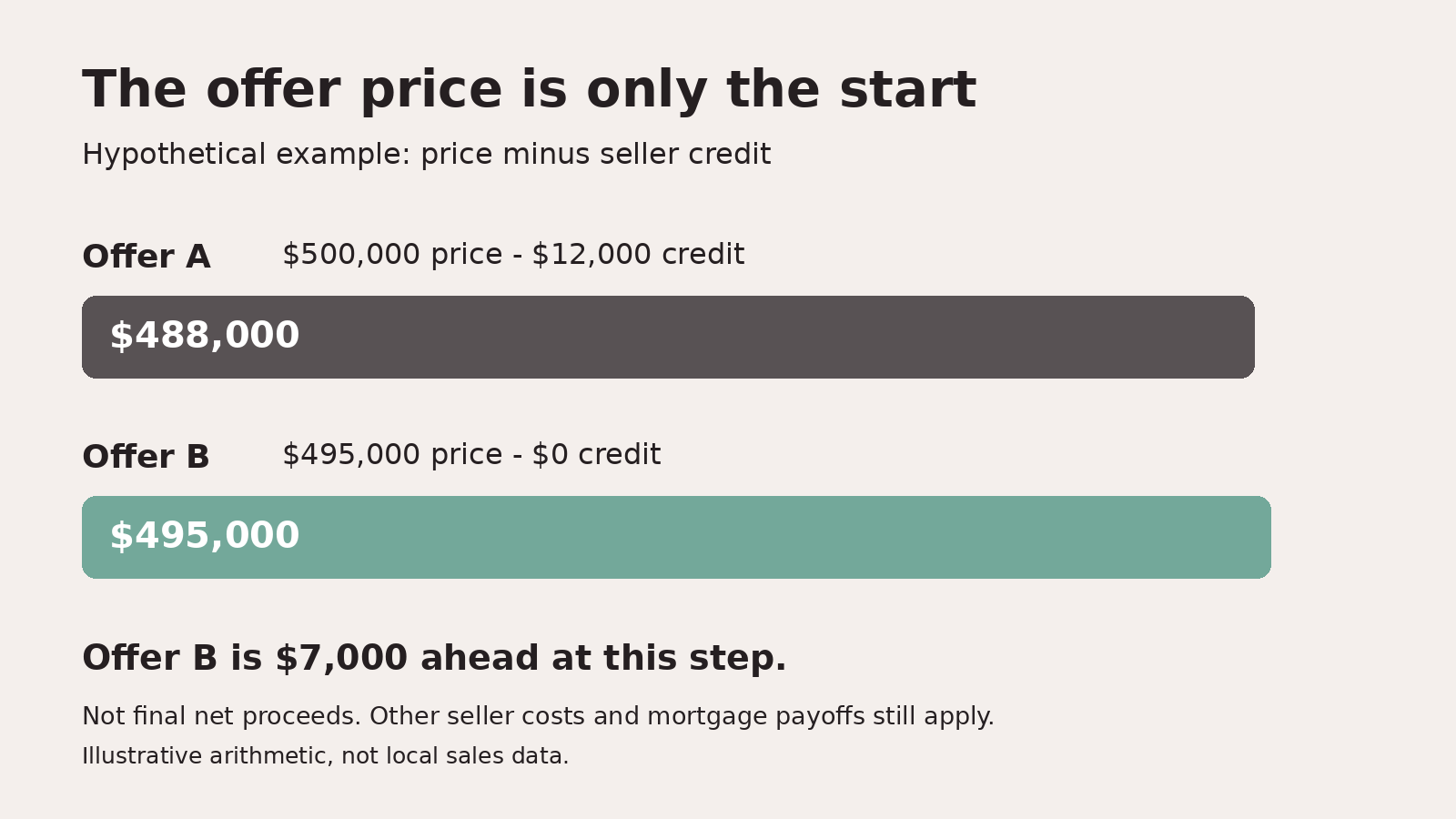
Illustrative comparison: hypothetical offer prices minus seller credits, before other seller costs.
An offer with a bigger number gets your attention. An offer that leaves you more money, closes on a workable schedule and has terms you understand deserves your attention.
For Las Vegas and Henderson sellers, that distinction matters whether you have one offer to negotiate or several to compare. Don't stop reading at the purchase price. The National Association of REALTORS' consumer guide points to financial terms, contingencies, closing timelines and earnest money as factors alongside price.
First, compare what you keep
A buyer may offer more but ask you to contribute toward closing costs. The CFPB describes a seller credit as the amount the seller agrees to contribute to the buyer's closing costs. That's money to include in your comparison, not a footnote.
Here's a made-up example, not a Las Vegas market statistic:
• Offer A: $500,000 purchase price, with a $12,000 seller credit. Price minus that credit: $488,000.
• Offer B: $495,000 purchase price, with no seller credit. Price minus that credit: $495,000.
Offer B is $7,000 ahead at this step, despite the lower headline price. Neither figure is your final take-home amount. Mortgage payoffs, agreed selling costs, repairs, prorations and other charges still have to be considered. Ask for an estimated seller net sheet for each offer, using the actual terms and clearly marked assumptions.
Then, read the conditions and the calendar
A contingency is a condition that needs to be met for the purchase to be completed. NAR's contingency guide describes financing, appraisal, inspection and the sale of a buyer's current home among the common examples.
Ask what each condition requires, when it must be satisfied and what the contract says happens if it isn't. A buyer waiting to sell another property has a different path to closing than a buyer who isn't. An inspection deadline and an appraisal provision deserve more than a quick skim.
Look at possession as well as closing. When do you have to leave? Does that fit your next home, moving plans and any agreed occupancy arrangement? The fastest closing isn't automatically the most useful one.
A lender letter isn't a finish line
Preapproval is useful, but it isn't a guaranteed loan offer. The CFPB also warns that lenders use "prequalification" and "preapproval" differently. The heading on the letter doesn't tell you everything about what was checked.
Have your agent help clarify the financing documentation, remaining conditions and proposed timeline. For a cash offer, request appropriate proof of funds and still read the contract. Cash removes the mortgage step; it doesn't make inspection terms, title issues or deadlines disappear.
Choose the trade-off, not the headline
Before accepting, put the offers side by side: estimated net proceeds, financing or funds documentation, contingencies and deadlines, closing date and possession. Then decide which combination fits your priorities.
This isn't a reason to reject a financed buyer or demand that buyers give up protections. It's a reason to understand what you're agreeing to. Contract rights depend on the actual wording and applicable law; get legal advice when you need it.
If you're preparing to sell in Las Vegas or Henderson, message me. We'll compare the dollars and the details, so the biggest font on page one doesn't make the decision for you.
